

For many enterprise organizations, marketing automation is already a major part of the revenue process. Platforms such as Oracle Eloqua help marketing teams manage campaigns, nurture prospects, segment audiences, and track engagement.
But there is a bigger question for business leaders:
Is Eloqua only running marketing campaigns, or can its data support better revenue decisions?
The difference matters, and this is where turning Eloqua into a revenue intelligence layer becomes valuable.

What Is a Revenue Intelligence Layer?
A revenue intelligence layer brings together relevant customer and prospect signals so revenue teams can understand what is happening across the buyer journey.
In simple terms, it helps answer questions such as:
- Which accounts are becoming more engaged?
- What content are prospects responding to?
- Which leads are showing meaningful buying signals?
- Where are prospects progressing or slowing down?
- Which marketing activities are connected to pipeline?
- Where should sales or marketing take action?
Traditional marketing automation focuses heavily on execution. Revenue intelligence focuses on turning data into better decisions and actions.
For an enterprise business, this distinction matters. Marketing may have campaign data, sales may have CRM data, and customer teams may have their own information. If these signals remain disconnected, leadership can struggle to see the full revenue picture.
A revenue intelligence approach aims to make those signals more useful across the organization.
Why can Eloqua play a bigger role?
Oracle Eloqua is designed for marketing automation and campaign management. Its capabilities include campaign execution, lead management, segmentation, personalization, and reporting.
That makes it a valuable source of marketing and engagement data.
The opportunity is to connect that information with the broader revenue process.
For example, marketing activity can provide context on how an account or prospect engages with a company. When teams connect this information with other relevant revenue data, they can build a clearer picture of customer interest and progression.
Instead of looking at an email click as an isolated event, teams can consider it alongside other relevant signals.
The strategic shift is simple:
Do not just ask what happened in a campaign. Ask what the activity means for the revenue journey.
The Business Problem: Marketing Data Is Often Trapped in Silos
Many organizations have plenty of data but still lack a clear view of revenue performance.
Marketing may track campaign engagement. Sales may track opportunities. Customer teams may track account activity. Finance ultimately tracks revenue.
Each team may have useful information, but disconnected systems and processes can make it difficult to connect these signals.
This can create several problems:
- Marketing cannot clearly show revenue impact
- Sales may lack buyer context
- Teams can miss important signals
Reporting can become a time-consuming exercise
How does an Eloqua Revenue Intelligence layer change the model?
The shift can be summarized as:

Instead of stopping at campaign performance, organizations can look for signals that help explain customer behavior and revenue movement.
For example, consider an account that has shown increasing engagement across several marketing activities.
One activity by itself may not mean much.
But a pattern of relevant engagement could indicate that the account deserves closer attention. When combined with other available information, that pattern can help marketing and sales teams decide what to do next.
This is the core idea behind a revenue intelligence layer: turning available signals into useful business context.
Business Case for turning Eloqua into a Revenue Intelligence Layer:
The value of this approach ultimately comes down to business outcomes.
1. Improve Marketing ROI:
Marketing leaders are under increasing pressure to demonstrate business impact.
A revenue intelligence approach can help organizations connect marketing activity with downstream outcomes such as pipeline and revenue.
This can support better decisions about where to invest marketing resources.
Instead of simply asking which campaign generated the most engagement, leadership can ask:
Which programs are contributing to the revenue strategy?
That is a much more valuable business question.
2. Increase Sales Efficiency:
Sales teams do not have unlimited time.
If marketing and revenue data provide useful context about prospects and accounts, sales teams can spend less time understanding basic engagement history and more time having relevant conversations.
The goal is not to send sales teams more data.
The goal is to give them more useful context.
3. Improve Lead Quality:
A lead score alone may not provide enough context.
Organizations can consider multiple signals when evaluating whether a prospect appears ready for additional engagement.
This can include engagement patterns, content interactions, account activity, and other relevant signals available within the organization’s technology environment.
Better context can support better prioritization and more informed sales handoffs.
4. Support Faster Revenue Decisions:
Timing matters in B2B buying journeys.
When organizations can identify meaningful changes in engagement, they can respond more appropriately.
Marketing can adjust nurture activities. Sales can prioritize relevant accounts. Revenue leaders can gain better visibility into what is changing in the funnel.
The objective is not simply to collect signals.
It is to reduce the time between a meaningful signal and an appropriate action.
5. Extend Intelligence Beyond New Business:
Revenue intelligence should not stop when a prospect becomes a customer.
Customer engagement data can also help organizations identify potential opportunities for expansion, cross-sell, upsell, or stronger customer engagement.
This creates a broader view of the revenue lifecycle, from acquisition to retention and growth.
Where AI fits into the Eloqua Revenue Intelligence Layer?
AI can make this model more powerful by helping teams process large amounts of information and identify patterns.
For example, AI can potentially help organizations:
- Detect changes in engagement
- Identify meaningful intent signals
- Prioritize accounts
- Summarize account activity
- Recommend next actions
- Support content personalization
- Identify potential funnel risks
The important point is that AI should not simply create another dashboard. Its value comes from helping teams move from data to decisions.
From Data to Action: A Simple Revenue Intelligence Workflow
A practical model can be represented as:
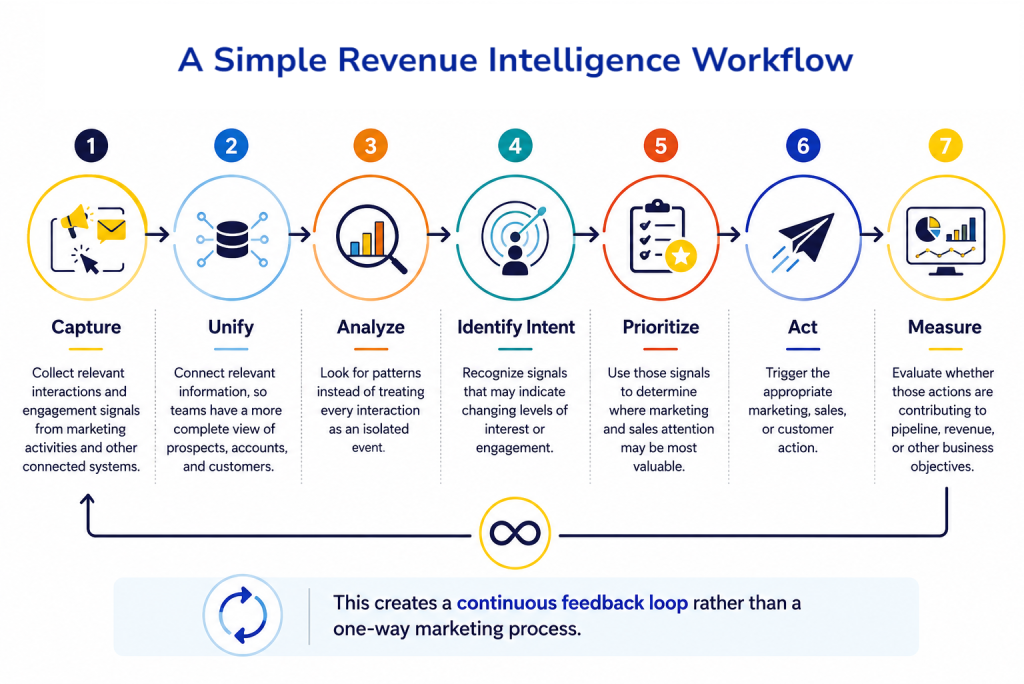
What business should measure?
A revenue intelligence strategy should move beyond basic engagement metrics.
Executives should consider business-focused measures such as:
- Marketing-sourced pipeline
- Marketing-influenced revenue
- Lead-to-opportunity conversion
- Pipeline velocity
- Sales acceptance rate
- Time to sales engagement
- Account engagement
- Customer expansion revenue
- Revenue contribution by marketing program
- Marketing ROI
The exact metrics will depend on the organization’s business model and measurement framework.
The larger principle is straightforward:
Do not measure more simply for the sake of measurement. Measure what helps leadership make better revenue decisions.
What it takes to turn Eloqua into a Revenue Intelligence Layer?
Turning an existing marketing automation investment into a broader intelligence capability requires more than enabling another feature.
It starts with a strong data foundation.
- Build a Reliable Data Foundation – Keep customer and prospect data accurate, consistent, and useful.
- Connect the Revenue Ecosystem – Connect Eloqua with CRM, sales, and customer data for a broader revenue view.
- Add Intelligence – Use segmentation, scoring, behavioral insights, and AI to identify valuable signals.
- Activate Insights – Turn relevant signals into marketing, sales, and customer actions.
- Measure Business Impact – Connect marketing intelligence to business outcomes and revenue performance.
Get more from the Investment you already have:
For many organizations, the first step does not have to be buying another platform. It can be evaluating how organizations use existing investments.
If Eloqua already supports important marketing processes and generates valuable engagement data, leadership should ask whether that information can play a larger role in the revenue strategy.
The goal is not to turn every marketing platform into an all-purpose technology stack.
The goal is to make relevant data more actionable.
When marketing signals drive better prioritization, stronger sales alignment, faster decisions, and clearer measurement, the underlying technology’s value extends beyond campaign execution.
Ready to explore what a revenue intelligence layer could look like for your organization?
Marketing automation is evolving from campaign execution to revenue intelligence. By turning Eloqua data into actionable signals, organizations can better understand customer interest, identify opportunities, support revenue decisions, and measure marketing impact against business outcomes. Marmato Digital can help you build a stronger revenue intelligence layer on your Eloqua data. Ready to explore what’s possible? Contact us today!
Subscribe to Newsletter
Get our latest blogs directly to your inbox.


