

In modern B2B marketing, organizations rely on platforms like Eloqua to improve lead management and drive revenue growth. However, poor data quality, including duplicate, incomplete, or outdated records, can disrupt lead routing, slow sales response times, and reduce marketing ROI. Data cleansing is now a critical revenue operations strategy that helps businesses improve lead routing accuracy, sales efficiency, and overall performance.

Why Lead Routing problems start with dirty data?
Most lead routing problems stem not from the automation logic itself, but from poor-quality data entering the system.
Lead routing depends on reliable attributes such as:
- Geography
- Industry
- Company size
- Job role
- Territory
- Product interest
- Account ownership
Routing workflows become ineffective when these fields contain inaccurate or inconsistent data.
For example:
- A lead missing the country field cannot be routed to the appropriate regional sales team.
- Duplicate records can cause the same prospect to be routed to multiple SDRs.
- Outdated job titles can lead to incorrect lead scoring and prioritization.
- Non-standardized values may trigger conflicting routing rules.
Marketing automation amplifies both good and bad data quality. Clean data improves operational efficiency. Dirty data accelerates operational chaos.
Common Data Quality Issues in Eloqua:
Organizations using Eloqua often encounter several recurring data quality challenges.
- Incomplete Lead Data:
Missing fields are one of the common routing obstacles. Without this information, automated workflows cannot accurately assign leads.
- Duplicate Records:
Duplicates create confusion across both marketing and sales teams. It creates inconsistent engagement histories and lead routing conflicts.
- Outdated Contact Information:
B2B data changes constantly. Professionals switch companies, receive promotions, or move into new territories. Without ongoing cleansing and enrichment processes, routing decisions are made using obsolete information.
- Non-Standardized Field Values:
Data inconsistency is another major issue. The lack of standardization reduces the reliability of automation.
Data Cleansing Strategies for Better Lead Routing:
Improving lead routing accuracy requires a structured data quality framework. The following strategies help organizations build cleaner, more reliable lead management systems in Eloqua.
1. Standardize Critical Routing Fields:
Standardization is the foundation of effective lead routing. Organizations should normalize key fields such as Country, State or region, Industry, Job title, Company size, and Lead source. Controlled picklists and predefined value structures help reduce inconsistencies.
For example, instead of allowing free-text country fields, organizations should use standardized dropdown options to ensure routing rules accurately recognize geographic data.
Standardized fields also improve:
- Segmentation accuracy
- Reporting consistency
- Campaign personalization
- Lead scoring reliability
2. Implement Duplicate Detection and Merge Processes:
Duplicate prevention should be proactive, not reactive. Organizations should define rules to detect duplicate records using email addresses, company domains, CRM IDs, and phone number combinations.
After identifying duplicates, organizations should establish a clear strategy for merging records.
Typical merge considerations include:
- Most recently updated record
- Most complete profile
- Existing CRM ownership
- Historical engagement activity
A strong deduplication framework improves:
- Sales productivity
- Pipeline visibility
- Customer experience
- Campaign accuracy
Most importantly, it prevents multiple sales representatives from contacting the same lead simultaneously.
3. Create a Data Completeness Scoring Model:
Not all leads are equally ready for routing. Organizations can improve routing quality by assigning a “routing readiness” or completeness score based on the availability of essential data fields. This approach prevents incomplete leads from entering sales workflows prematurely.
For example, high-weightage data attributes, such as Valid Email Address and Territory Information. Medium-weightage data attributes, such as Industry, Job Role, and Company Size.
Based on scoring thresholds:
- High-quality records can be auto-routed
- Medium-quality records can enter enrichment workflows
- Low-quality records can be held for validation
4. Use Progressive Profiling for Ongoing Data Enrichment:
Many organizations make the mistake of collecting too much information upfront. Long forms reduce conversion rates and create friction. Progressive profiling solves this problem by gradually collecting additional data over time through:
- Forms
- Email engagement
- Events
- Web behavior
- Intent signals
- Third-party enrichment tools
This strategy balances customer experience with data quality improvement. Over time, organizations build richer lead profiles without overwhelming prospects during initial interactions.
5. Automate Data Validation Before Lead Routing:
Validation workflows prevent bad data from entering routing systems. Validation reduces routing failures and improves operational consistency.
Automated validation rules can:
- Verify email formatting
- Validate geographic consistency
- Detect invalid territories
- Flag missing mandatory fields
- Identify suspicious entries
For example:
- A lead with a Canadian province but a US ZIP code can be flagged for review.
- Leads missing territory assignments can enter enrichment workflows before sales distribution.
6. Align Sales and Marketing Data Governance:
Technology alone cannot solve lead routing problems. Many routing failures occur because marketing and sales teams operate with different definitions, ownership rules, and territory structures.
Organizations should establish shared governance frameworks covering:
- Lead ownership rules
- Territory definitions
- Data standards
- SLA expectations
- CRM synchronization policies
Cross-functional governance improves accountability and ensures routing logic remains aligned with business objectives.
Advanced Lead Routing Optimization Techniques:
As organizations mature, they can enhance routing accuracy using more advanced operational strategies.
- AI-Assisted Data Cleansing:
AI-driven systems can help identify duplicate records, anomalous data patterns, incomplete profiles, and predictive routing opportunities.
Machine learning models can also prioritize leads based on engagement behavior and historical conversion patterns. However, AI systems still depend on clean foundational data. Poor-quality inputs will continue to produce unreliable outputs.
- Real-Time Data Hygiene Automation:
Leading organizations are shifting from periodic cleanup projects to continuous data hygiene operations. Continuous maintenance prevents data decay and preserves routing accuracy over time.
This includes scheduled cleansing workflows, automated normalization, CRM synchronization monitoring, inactive contact suppression, and dynamic enrichment programs.
Key Metrics to Monitor:
To evaluate routing effectiveness, leadership teams should monitor both operational and revenue-related KPIs.
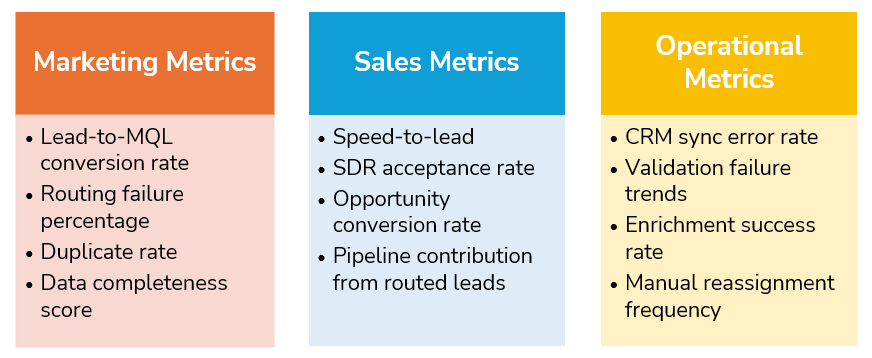
These metrics help organizations identify whether routing inefficiencies stem from process design or underlying data quality issues.
Building a Data Cleansing Framework to improve lead routing:
Effective data cleansing is not a one-time initiative. It requires continuous operational discipline. A sustainable framework typically includes four phases:
Phase 1: Audit
Identify:
- Duplicate trends
- Missing data patterns
- Routing failures
- Field inconsistencies
Phase 2: Standardize
Normalize:
- Field structures
- Naming conventions
- Territory definitions
- Data formats
Phase 3: Automate
Implement:
- Validation workflows
- Cleansing automation
- Deduplication rules
- Enrichment processes
Phase 4: Govern
Establish:
- Ongoing monitoring
- Executive accountability
- Quarterly data reviews
- Cross-functional ownership
Organizations that operationalize data governance consistently outperform those relying on reactive cleanup efforts.
Conclusion:
Lead routing is one of the most critical components of revenue operations. Yet even the best automation strategies fail when powered by poor-quality data. You must recognize that data cleansing is not simply a technical maintenance activity; it is a strategic business function directly tied to revenue growth, sales productivity, and customer experience. By implementing structured data cleansing strategies, businesses can significantly improve routing precision and operational efficiency.
Is your lead routing strategy being slowed down by dirty data?
Subscribe to Newsletter
Get our latest blogs directly to your inbox.


