Is your Marketo ROI delivering the business value your organization expected?
Adobe Marketo Engage helps organizations automate marketing, manage campaigns, segment audiences, nurture leads, and measure performance. However, strong return on investment depends on more than the platform itself. Data quality, processes, campaigns, integrations, and team efficiency all matter.
As marketing operations grow, maintaining campaigns, managing data, and monitoring integrations can make it harder to maximize Marketo ROI.
AI-powered marketing operations can help. AI can identify issues, reduce repetitive work, analyze information faster, and improve how you use Marketo. Adobe is also adding AI capabilities to Marketo Engage for areas such as data normalization, program validation, lead investigation, and analytics.
For business, the key question is simple: Can AI help the organization get more measurable Marketo ROI from the technology it already owns?
Why Marketo ROI is more than a technology question?
A strong Marketo ROI strategy should begin with business outcomes, not platform activity.
It is easy to measure how many campaigns were launched, emails were sent, or programs were created. But those numbers don’t necessarily show whether the marketing investment is creating meaningful business value.
A better approach connects marketing operations with outcomes such as:
- Pipeline contribution
- Lead quality
- Conversion rates
- Campaign efficiency
- Marketing productivity
- Revenue impact
Adobe’s marketing impact analytics capabilities connect campaign and channel activity with cost, pipeline, revenue, conversion, and attribution data. This provides a stronger foundation for evaluating ROI than measuring marketing activity alone.
What Business Leaders should measure for Marketo ROI?
Executives evaluating Marketo ROI should consider questions such as:
- How much pipeline is marketing influencing?
- Are marketing-generated leads converting into qualified opportunities?
- How efficiently are campaigns being produced and managed?
- How much time does the marketing operations team spend on repetitive work?
- How quickly can teams identify and resolve operational problems?
- Is marketing data reliable enough to support segmentation, personalization, reporting, and sales processes?
A highly active Marketo instance can still produce weak Marketo ROI if teams spend too much time maintaining workflows, correcting data, troubleshooting integrations, or manually preparing reports.
Where Marketing Operations can reduce Marketo ROI?
Operational challenges that can reduce Marketo ROI:
- Manual campaign setup can take up valuable team time.
- Inconsistent data can affect segmentation, workflows, and reporting.
- Duplicate records can create confusion and affect marketing processes.
- Complex workflows can require more time to manage and troubleshoot.
- Reporting gaps can make it harder to measure marketing performance.
- Integration issues can disrupt data flow between systems.
Data quality is particularly important. Poor data quality can impact workflows when duplicate or incomplete records are used. The impact may not always appear as a direct financial loss. It can show up as:
- Slower campaign execution
- Lower team productivity
- Unreliable reporting
- Delayed business decisions
Together, these challenges can limit the potential Marketo ROI.
The Growing Case for AI-Powered Marketing Operations and Marketo ROI
The goal for Marketo ROI should not be to replace marketing professionals. The goal should be to help experienced teams spend less time on repetitive execution and more time on strategy, optimization, and decisions that require business judgment.
In simple terms, AI-powered marketing operations means using AI to help marketing teams understand data, identify potential problems, automate selected operational tasks, and prioritize where human attention is needed.
Where AI Can Help Maximize Marketo ROI?
- Improve Marketing Data Quality – Better data improves Marketo ROI by strengthening segmentation, personalization, reporting, and lead management. AI can help identify and organize data issues, reducing manual work and supporting more reliable marketing processes.
- Improve Campaign Operations – AI can improve ROI by reducing repetitive campaign QA, workflow checks, and troubleshooting. Better consistency can help teams manage more campaigns without increasing operational complexity at the same rate.
- Improve Lead Management – AI can help teams quickly identify issues in lead activity and lifecycle progression. This can improve lead management, support faster problem-solving, and contribute to better return on investment.
- Improve Reporting and Decision-Making – Strong Marketo ROI requires turning marketing data into actionable insights. AI can help teams identify patterns faster and focus on opportunities to improve it.
- Improve Marketing Team Productivity – AI can help reduce repetitive operational work. This gives marketing teams more time for strategy, customer journeys, campaign improvement, and analysis.
Building the Business Case for AI-Powered Marketing Operations and Marketo ROI:
Start With the Current Cost of Operations for Marketo ROI
Look at how much time your organization spends on:
- Repetitive campaign tasks
- Campaign production and QA
- Data cleanup
- Duplicate management
- Troubleshooting
- Reporting
- Manual analysis
- Operational issue resolution
The objective is to understand where existing processes consume time and where those costs may be limiting Marketo ROI.
Measure the Potential Business Impact on ROI:
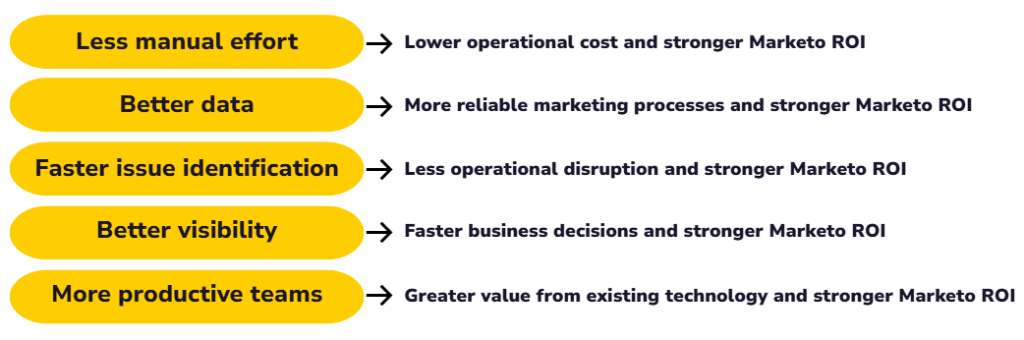
The business case can then connect operational improvements with measurable outcomes rather than technology adoption alone.
Look beyond cost savings when measuring Marketo ROI:
AI should not be justified only through headcount reduction.
A broader Marketo ROI assessment can consider productivity, speed, data quality, campaign consistency, decision-making, operational resilience, and the ability to scale marketing programs.
The right question is not simply, “How much money will AI save?”
The better question for Marketo ROI is, “How much additional business value can we create by making our marketing operations more efficient and intelligent?”
What business should ask before investing in AI for Marketo ROI?
Before investing in AI for better Marketo ROI, executives should ask four questions:
- Is the problem clearly defined? Identify the biggest operational challenges and where manual effort occurs.
- Can AI solve it? Confirm that AI is the right fit and keep human oversight where needed.
- Can we measure the impact? Set a baseline and track changes in time, efficiency, and performance.
- Are we maximizing our current Marketo investment? Improve data, workflows, and existing capabilities before adding new technology.
A Practical Path to AI-Powered Marketing Operations and Marketo ROI:
Step 1: Assess Current Operations to Establish Marketo ROI
Review your campaigns, data, integrations, workflows, reporting, and operational processes.
Identify the bottlenecks that consume the most time or create the greatest business risk. This gives leadership a baseline for Marketo ROI.
Step 2: Identify High-Value AI Use Cases for Marketo ROI
Prioritize opportunities based on:
- Business impact
- Frequency of the problem
- Manual effort involved
- Data availability
- Ability to measure results
- Level of human oversight required
The strongest Marketo ROI opportunities are usually problems that occur frequently, consume meaningful resources, and have measurable outcomes.
Step 3: Start Small to Prove Marketo ROI
Choose one or two high-value use cases.
Establish a baseline, test the approach, and measure the results. A focused pilot can provide stronger evidence of Marketo ROI than a broad AI rollout with unclear objectives.
Step 4: Scale What Works to Increase Marketo ROI
Once a use case demonstrates measurable ROI, expand it carefully.
Create governance, maintain human oversight, document processes, and continue measuring outcomes. Adobe’s Marketo AI documentation emphasizes existing permissions, governance, and reviewability of AI-generated outputs.
Conclusion:
Better Marketo ROI is about making marketing operations more efficient, data-driven, measurable, and intelligent. AI can reduce repetitive work, improve data quality, and support faster analysis, but the focus should remain on solving clear business problems and measuring real results.
Is Your Marketo ROI Delivering Enough?
Is your Marketo investment delivering the operational efficiency and business value your organization expects from its Marketo ROI? Assess your marketing operations to identify inefficiencies, improve productivity, and uncover where AI can create measurable impact. Marmato Digital can help you start with the right business problem, measure the opportunity, and turn your existing Marketo investment into greater business value. Contact us now!
Subscribe to Newsletter
Get our latest blogs directly to your inbox.