AI-generated emails are easy to measure. Proving they drive revenue is harder.
AI helps marketing teams create campaign content faster, but faster production alone doesn’t guarantee business growth. The real value lies in generating qualified leads, improving conversions, and increasing revenue.
Opens and clicks measure engagement, but they don’t show whether the campaign drives business results.
Measure success by linking email performance to revenue and opportunities, considering audience quality, timing, and sales efforts.
This article explains how to measure the business impact of AI-generated email in Marketo Engage and build a strong business case for adoption.
The Business Problem: Better Emails Do Not Automatically Mean More Revenue
Email plays an important role in B2B marketing. It helps businesses nurture leads, educate customers, follow up after events, and support sales.
But creating effective emails takes time. Teams must understand their audience, write the right message, follow brand guidelines, get approvals, and launch campaigns.
AI can help by drafting subject lines, personalizing content, and creating email variations for different audiences.
The aim is to deliver targeted emails that motivate prospects to move forward.
The key question is: Do AI-generated emails perform better than the emails your team already sends?
Also consider these three questions:
- Efficiency: Does AI reduce the time and effort required to produce approved emails?
- Effectiveness: Do AI-assisted emails improve meaningful engagement and conversion?
- Commercial impact: Does that improvement translate into more qualified opportunities, faster progression through the sales pipeline, or lower cost per opportunity?
These questions should guide adoption from the beginning. Without them, teams risk reporting content volume and engagement gains without demonstrating whether the investment supports business growth.
What AI-Generated Email Changes in Marketo Engage?
Marketo Engage helps teams manage campaigns and track results. AI can speed up email creation by drafting messages and tailoring content for different audiences. Marketers must review all content for accuracy, brand fit, and compliance before sending.
AI helps create the email, while Marketo manages the campaign and tracks its results.
The AI features available depend on the tools, licenses, and setup an organization uses. Teams should confirm which features are available before planning implementation.
A revenue-focused workflow connects four activities:
- Define the audience – Identify the segment, customer need, lifecycle stage, and desired next action.
- Generate and review content – Use AI to assist with drafting or adapting email content. Apply human review and approval controls.
- Execute the campaign – Deliver the approved email through the configured marketing automation workflow and track subsequent actions.
- Connect activity to outcomes – Evaluate engagement, conversions, opportunity progression, and costs using consistent reporting rules.
This approach moves the conversation beyond how many emails AI can produce. It asks whether the content helps customers progress toward a business decision.
Use Cases that Connect AI Generated Email to Revenue:
The following scenarios illustrate where AI-assisted email may create measurable business value. The results are illustrative, not reported Marketo performance or guaranteed outcomes.
Use case 1: Lifecycle nurture that moves prospects toward a sales conversation.
The situation:
A prospect downloads a guide but isn’t ready to talk to sales. The marketing team adds them to an email series that educates potential buyers over time.
What AI-generated email changes:
AI helps the team tailor email drafts for different audience segments. Prospects exploring a problem receive educational content, while those evaluating solutions get information about implementation.
The team reviews each draft, checks that the information is accurate, and sends the approved versions through its existing campaign process.
What to measure:
- Conversion rate of nurtured prospects who take the next agreed step.
- Sales-accepted leads generated per eligible prospect.
- Marketing-qualified leads progressing to sales opportunities.
- Time from initial nurture entry to qualification.
- Cost per qualified opportunity.
Illustrative example:
In an existing nurture program, 50 out of 1,000 prospects become qualified opportunities (5%). With AI-assisted emails, 65 prospects qualify (6.5%).
That’s 15 more opportunities and a 1.5 percentage-point increase in conversion. However, the team must check whether other factors influenced the results before crediting AI for the improvement.
Use case 2: Re-engage inactive contacts with the highest potential value.
The situation:
The database includes contacts who interacted with the business before but are no longer responding. Sending them the same generic emails can waste campaign resources without getting results.
What AI-generated email changes:
AI helps create tailored messages for different audience segments. For example, subscribers may receive educational resources, while contacts who explored a solution may receive an invitation to discuss their business needs.
Always follow consent, privacy, and communication rules. AI must not make up personal information or guess what customers want without proof.
What to measure:
- Reactivation rate among eligible dormant contacts.
- Qualified responses and meeting bookings.
- Reactivated contacts that progress to opportunities.
- Cost per reactivated qualified contact.
- Unsubscribe, complaint, and bounce rates as guardrails.
Illustrative example:
An AI-assisted re-engagement campaign gets more clicks but no increase in qualified meetings.
This means engagement improved, but business results did not. The team should review the target audience, offer, and landing page before judging success.
More clicks don’t always lead to more sales opportunities.
Use case 3: Sales-handoff follow-up that reduces delays.
The situation:
A prospect meets a qualification threshold and is passed to sales. A follow-up email is required, but delays can occur while teams prepare messaging, coordinate responsibilities, or adapt content to the prospect’s needs.
What AI-generated email changes:
AI creates follow-up email drafts based on approved product details and campaign information. A team member checks the content before sending.
AI helps create content, but people remain responsible for accuracy and final decisions.
What to measure:
- Time from qualification to first appropriate follow-up.
- Percentage of qualified leads followed up with on time.
- Meeting-booking rate.
- Sales acceptance rate.
- Opportunity creation rate and subsequent progression.
Illustrative example:
AI helps the team draft follow-up messages quickly and contact leads promptly.
If meetings and new opportunities don’t increase, the benefit is better efficiency, not additional revenue. Report these results separately.
The Measurement Framework: From Engagement to Revenue
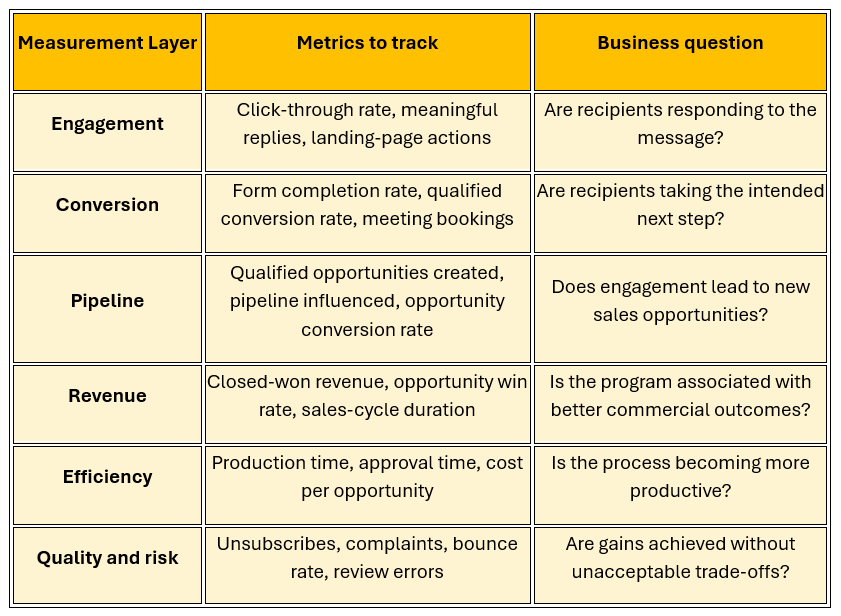
A reliable measurement plan tracks engagement, business results, and costs together instead of focusing on just one metric.
Establish a Baseline Before Introducing AI:
Without baseline data, teams can’t tell whether AI-assisted emails deliver better results.
Before testing AI, record current campaign performance and compare it with a similar audience, campaign type, and time period.
A practical baseline should include five elements:
- Audience: Define eligible contacts, segments, exclusions, and qualification criteria.
- Performance: Record existing engagement, conversion, opportunity, and cycle-time metrics.
- Production effort: Track the time spent drafting, editing, reviewing, approving, and sending emails.
- Costs: Record labor, platform, AI, and campaign expenses.
- Attribution rules: Define which actions count toward conversions or sales opportunities influenced by email campaigns.
Review historical campaign data and account for seasonality, sales cycles, and changes in your audience.
Then, change only one thing in the test, such as AI-assisted copy. Changing the offer, audience, or landing page too makes it harder to know what drove the results.
Key Takeaways:
- Set a clear goal: Identify where AI can improve Marketo Engage campaigns.
- Establish a baseline: Record current performance and costs before testing AI.
- Track business outcomes: Monitor conversions, sales pipeline, revenue, and efficiency.
- Validate results: Use control groups when possible to measure AI’s impact and rule out other factors.
- Ensure quality: Maintain human review, accurate content, and privacy compliance.
- Scale strategically: Expand AI use only when the benefits justify the costs.
Bottom line: AI-generated emails should do more than save time. They should improve business results, backed by reliable data.
Want to measure the real business impact of AI in Marketo Engage?
Subscribe to Newsletter
Get our latest blogs directly to your inbox.