Poor data quality is expensive. Gartner estimates it costs organizations an average of $12.9 million each year. Often, the problem starts with something as simple as inconsistent field values across marketing and CRM systems.
These small inconsistencies can lead to inaccurate reporting, inefficient operations, missed revenue opportunities, and poor business decisions. As organizations invest in AI and automation, data quality becomes more important than ever.
One simple but powerful solution is Picklist Management in Marketo. It helps create consistent, reliable data that improves reporting, streamlines operations, and supports smarter business decisions.
In this article, you’ll learn why Picklist Management should be viewed as a strategic business investment, not just an administrative feature.
What is Picklist Management?
Picklist Management in Marketo is a data governance feature that standardizes field values by allowing only predefined options, helping organizations maintain clean, consistent, and reliable marketing data.
Previously, Marketo stored CRM picklist fields (for example, Salesforce picklists) as plain String fields in the Lead Database. This meant:
- Users could enter invalid values.
- Misspellings created inconsistent data.
- CRM sync failures occurred when values didn’t match the CRM.
- Reporting became fragmented due to inconsistent field values.
The new Picklist Management feature allows administrators to define and manage a controlled list of allowed values directly within Marketo for supported fields.
Why Picklist Management Matters?
- Better Data Quality:
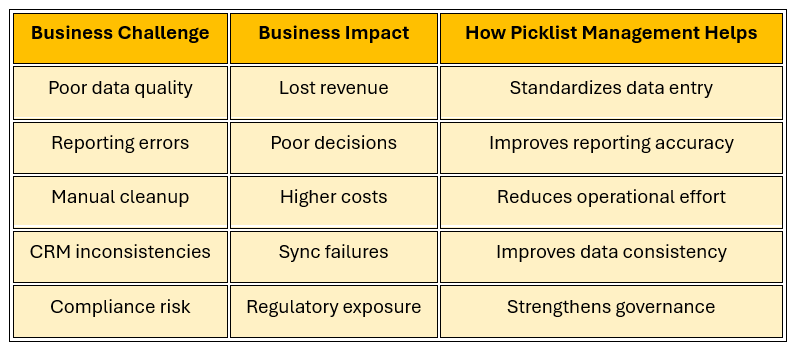
Standardizing field values keeps data clean and consistent, leading to more accurate reports, reliable dashboards, better analytics, and smarter business decisions.
- Greater Operational Efficiency:
Standardized data reduces manual work, helping teams spend less time fixing errors and more time launching campaigns. This improves productivity, lowers operational costs, and speeds up campaign execution.
- Better Business Decisions:
Reliable, consistent data enables more accurate customer segmentation, campaign measurement, and strategic decisions, leading to improved marketing ROI, smarter budget allocation, and more accurate revenue forecasting.
- Stronger Governance:
Controlled values keep data consistent across systems, reduce compliance risks, improve audit readiness, minimize errors, and strengthen overall data governance.
How does Picklist Management Strengthen Integrated Marketing and Sales Funnels?
Marketing and sales teams rely on shared customer data to move prospects from awareness to revenue. When field values are inconsistent across Marketo and the CRM, it becomes difficult to track where prospects are in the buying journey, assign leads correctly, or measure campaign performance accurately.
Standardized picklists create a common language across both systems, ensuring that marketing and sales teams work from the same trusted data. This improves collaboration, reduces operational friction, and helps organizations deliver a consistent customer experience throughout the funnel.
Business Benefits of Picklist Management:
1. Better Lead Qualification:
Consistent values for Industry, Company Size, Region, and Lead Source improve lead scoring and segmentation accuracy.
Business Impact:
- Higher-quality leads for sales
- Better conversion from Marketing Qualified Leads (MQLs) to Sales Qualified Leads (SQLs)
- More efficient use of sales resources
2. Accurate Lead Routing:
Standardized data ensures leads are assigned to the right salesperson or team based on predefined business rules.
Business Impact:
- Faster response times
- Fewer routing errors
- Improved customer experience
3. Reliable Funnel Reporting:
Executive dashboards are only as accurate as the underlying data. Consistent picklist values provide a clear and accurate view of how prospects progress through the marketing and sales funnel.
Business Impact:
- Trusted pipeline reports
- More accurate revenue forecasting
- Better visibility into conversion rates
4. Stronger Sales and Marketing Alignment:
Shared data standards eliminate conflicting reports and improve collaboration between marketing, sales, and operations teams.
Business Impact:
- Common KPIs across departments
- Improved accountability
- Better strategic planning
5. Improved Revenue Attribution:
Consistent campaign and lead source values make it easier to understand which marketing activities generate pipeline and revenue.
Business Impact:
- Smarter marketing investments
- Better ROI measurement
- Increased confidence in budget decisions
Key benefits:
- Improved data quality by preventing invalid entries.
- Fewer Salesforce or Microsoft Dynamics synchronization errors.
- More reliable Smart Lists and segmentation.
- Cleaner reporting and dashboards.
- Reduced need for manual normalization campaigns and data cleanup.
CRM integration impact:
For organizations integrated with Salesforce or Microsoft Dynamics:
- CRM picklist values remain aligned with Marketo.
- Invalid values are prevented at data entry.
- Sync failures caused by unsupported values are reduced.
- Lead routing and automation become more reliable.
Why Picklist Management matters in an AI-Driven Business?
As organizations adopt AI for lead scoring, forecasting, personalization, and customer journey orchestration, the quality of AI insights depends on the quality of the underlying data.
Integrated marketing and sales funnels built on standardized picklists provide cleaner, more consistent data for analytics and AI models. This leads to more accurate predictions, better automation, and greater confidence in strategic decisions.
Executive Checklist:
Ask your team:
- Are marketing and CRM field values standardized?
- Can executives trust marketing dashboards?
- How much time is spent cleaning data?
- Are reporting inconsistencies delaying decisions?
- Is your marketing data ready for AI-driven insights?
If the answer to any of these is no, it’s time to review your data governance strategy.
Conclusion:
Picklist Management is more than a data administration feature. It is a business capability that improves data quality, increases operational efficiency, strengthens governance, and enables more confident executive decision-making.
Organizations investing in AI, advanced analytics, and revenue growth need a trusted data foundation. Standardizing picklists is a practical first step toward achieving it.
Optimize Your Marketo Picklists Today!
Clean data is the foundation of successful marketing, sales, and AI initiatives. If your organization is struggling with inconsistent data, unreliable reporting, or disconnected marketing and sales processes, it’s time to take a closer look at your data governance strategy. Marmato Digital can help you see how Marketo Picklist Management and effective data governance can improve data quality, streamline operations, and drive measurable revenue growth. Contact us today!
Subscribe to Newsletter
Get our latest blogs directly to your inbox.