

Car dealerships invest in digital advertising, search, social media, and marketing automation to attract buyers. But how much of that spend actually generates vehicle sales?
Clicks, impressions, and leads show marketing activity, not business results. A campaign can generate hundreds of inquiries without delivering enough showroom visits or sales to justify its cost.
The real measure of marketing success is how effectively these investments drive vehicle sales and dealership profitability.

Why Clicks and Leads Are Incomplete Measures of Marketing Success
High lead volume doesn’t always mean better marketing performance. Many inquiries may come from unqualified shoppers or prospects who never reach the showroom. Similarly, a low cost per lead doesn’t guarantee sales. Campaigns that attract fewer but higher-intent buyers may generate more actual vehicle sales.
Research from Cox Automotive, based on 875,000 automotive sales analyzed using Clarivoy data, found that only 8% of sales were traceable in CRM systems. The remaining 92% were not connected to a lead submitted through the dealership’s CRM. The research also found that buyers interacted with an average of four distinct channels during their shopping journey.
These findings highlight a major measurement gap: dealerships may be generating sales influenced by digital marketing without having the data to recognize that contribution.
Connect the Complete Dealership Customer Journey
Measuring digital marketing ROI through sold units requires tracking the entire customer journey, from the first search or ad interaction to vehicle research, inquiries, appointments, and showroom visits.
However, these interactions often sit in separate systems.
Dealerships need to connect:
- Advertising data: Campaigns, channels, and advertising sources.
- Website activity: Vehicle detail page views, inventory searches, and inquiries.
- CRM records: Customer profiles, lead sources, sales activities, and follow-ups.
- Showroom interactions: Appointments, visits, test drives, and trade-in evaluations.
- DMS records: Completed vehicle sales, sold VINs, and transaction details.
Connecting CRM and DMS data with marketing platforms helps dealerships understand which customer interactions are associated with completed sales.
This also requires consistent customer records and reliable data access. In its March 2026 discussion on dealer data ownership, NADA highlighted the importance of dealership control over one of its most valuable business assets: customer data.
Measure Marketing Performance Through Sold-Unit KPIs
Once marketing and sales data are connected, dealerships can evaluate campaigns using metrics that reflect actual business outcomes.
Important performance indicators include:
- Cost per lead: How much marketing investment generates an inquiry.
- Cost per appointment: How efficiently campaigns create showroom opportunities.
- Appointment show rate: How many scheduled appointments result in actual visits.
- Lead-to-sale conversion rate: How effectively leads become vehicle buyers.
- Cost per vehicle sold: How much marketing investment is associated with each completed sale.
- Marketing-attributed sold units: How many completed vehicle sales are associated with marketing interactions.
- Gross profit by campaign: The profitability of sales associated with individual campaigns.
- F&I revenue contribution: Additional transaction revenue associated with completed vehicle sales.
- Marketing ROI: How marketing investment compares with the gross profit attributed to those sales.
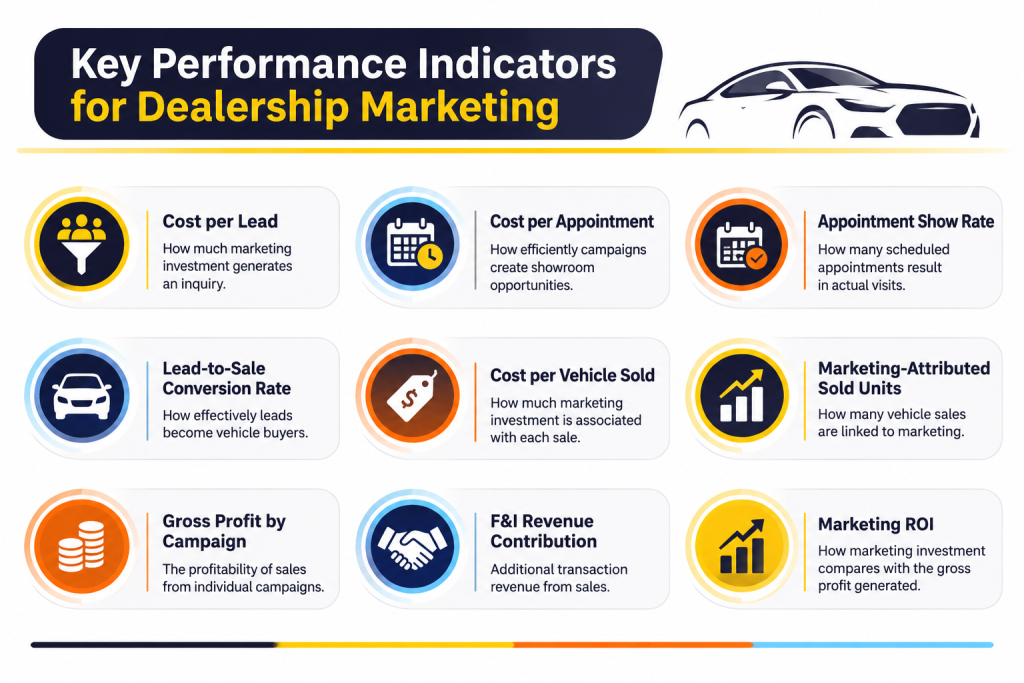
The distinction between lead generation and sold-unit performance is important. A campaign generating fewer leads may deliver stronger sales outcomes and better profitability.
As highlighted in The Stacc’s guide to car dealership marketing KPIs, dealerships benefit from tracking performance across the marketing funnel rather than evaluating individual metrics in isolation.
Understand Attribution Challenges in Automotive Dealerships
Connecting marketing activity to a vehicle sale is challenging. Buyers interact with multiple channels, websites, and dealership touchpoints before purchasing.
Last-touch attribution may overlook earlier interactions. Cox Automotive research highlights this gap: buyers averaged 62 touchpoints, while dealerships tracked only two.
Dealerships should use first-touch, last-touch, and multi-touch attribution to understand the customer journey. However, attribution shows associations with sales, not necessarily direct advertising impact.
Use AI and Connected Data to Improve Marketing Measurement
AI can help dealerships make better use of customer and marketing data when the underlying information is reliable and connected.
With the right technology foundation, dealerships can:
- Reconcile customer interactions across marketing platforms, CRM, and DMS.
- Identify advertising sources associated with completed vehicle sales.
- Compare lead quality and conversion performance across channels.
- Identify patterns in customer journeys that lead to sales.
- Detect conversion bottlenecks and underperforming campaigns.
- Improve audience targeting and follow-up through marketing automation.
The goal is not simply to introduce more AI tools. It is to give dealership teams a clearer view of marketing performance and the information needed to make better decisions.
Turn Marketing Reports into Revenue Intelligence
A connected marketing dashboard can combine advertising spend, inventory engagement, lead quality, appointments, showroom visits, sold units, and gross profit to help dealerships evaluate campaign performance.
Adsquare’s case study with automotive agency Sokal demonstrates this approach. Across four dealership locations, the campaign tracked dealership visits following digital ad exposure, helping compare channels and optimize campaign investments.
While showroom visits don’t guarantee vehicle sales, connecting digital campaigns with offline activity provides better visibility into marketing performance.
Measure What Your Marketing Actually Sells
Digital marketing success goes beyond clicks and leads. Dealerships need to connect marketing activity with showroom visits, vehicle sales, and profitability through integrated CRM, DMS, and analytics.
Marmato Digital helps dealerships connect marketing technology, CRM, AI, and data analytics to measure marketing performance and revenue outcomes.
Struggling to identify which campaigns actually sell vehicles? Book a consultation with Marmato Digital to uncover measurement gaps and connect marketing investments to sales results.
LET’S CONNECT AT NADA 2027!
Let’s discuss how AI, CRM, and automation can improve dealership performance and drive revenue growth.
Subscribe to Newsletter
Get our latest blogs directly to your inbox.


