

Your next vehicle sale may come from your existing customer database, not a new lead.
Service customers, previous buyers, trade-in prospects, and unconverted leads may already show buying signals through their purchase history, service records, and engagement.
By connecting CRM, DMS, sales, service, and finance data, dealerships can identify these opportunities and turn customer insights into sales.
The strategy is simple: Find the customers. Recognize the opportunity. Activate the sale.

Why Every Dealership Is Chasing the Same Buyers
Digital advertising helps dealerships reach vehicle shoppers, but competing dealers often target the same audiences. A customer browsing SUVs or comparing prices may see ads from multiple dealerships in the same market.
This creates three challenges:
- Overlapping audiences: Competing dealerships often target the same in-market shoppers.
- Increasing acquisition pressure: Dealers must compete for attention through paid search, social media, and automotive marketplaces.
- Limited audience visibility: Focusing primarily on active shoppers can leave existing customer relationships and future buying opportunities unexplored.
The challenge may not be finding more buyers but recognizing the opportunities already within your customer database. Connected vehicle, service, purchase, and finance records can reveal buying signals that traditional advertising may miss.
How Audience Segmentation Helps Dealerships Find Buyers?
The Untapped Audiences Sitting Inside Your Dealership Data
Your dealership may already have access to several customer groups with potential buying intent. The challenge is identifying which customers are ready for a relevant conversation.
Here are five audience segments worth exploring.
- Service customers
Customers bringing vehicles in for frequent repairs or major maintenance may be approaching a point where replacing their current vehicle becomes worth considering.
Cox Automotive’s November 2025 research found that more than half of customers facing major repairs might consider trading in their vehicles. The same research highlighted that many customers are not offered an appraisal.
This creates an opportunity for dealerships to connect service interactions with sales conversations.
- Previous buyers
A customer’s previous purchase date, vehicle model, and ownership history can help dealerships identify potential replacement opportunities.
For example, a customer who purchased a vehicle several years ago may be worth including in a replacement-cycle audience. This does not automatically mean they are ready to buy, but it gives the dealership a reason to assess their current needs.
- Trade-in prospects
Existing vehicle owners may be ready to trade in, particularly when their current vehicle’s estimated value and potential equity make an upgrade attractive.
Dealerships can use available ownership and valuation information to identify customers who may benefit from a trade-in assessment.
- Finance customers
Finance records can provide useful context about previous purchases and upcoming financing milestones.
Where permitted by applicable privacy, consent, and data-use requirements, dealerships can identify customers who may be interested in exploring replacement vehicles, financing options, or an upgrade.
- Unconverted prospects
Not every customer who submits an inquiry purchases a vehicle immediately. Some postpone their decision, choose another option, or simply stop responding.
However, their circumstances may change. A previous inquiry or lost opportunity can become relevant again when new inventory, pricing, or customer needs create a reason to reconnect.
These five segments demonstrate why dealerships should look beyond new leads. Existing customer relationships can provide another source of potential buyers.
How to Identify High-Potential Customer Segments
Having customer data isn’t enough. Dealerships must connect it to identify customers with potential buying intent.
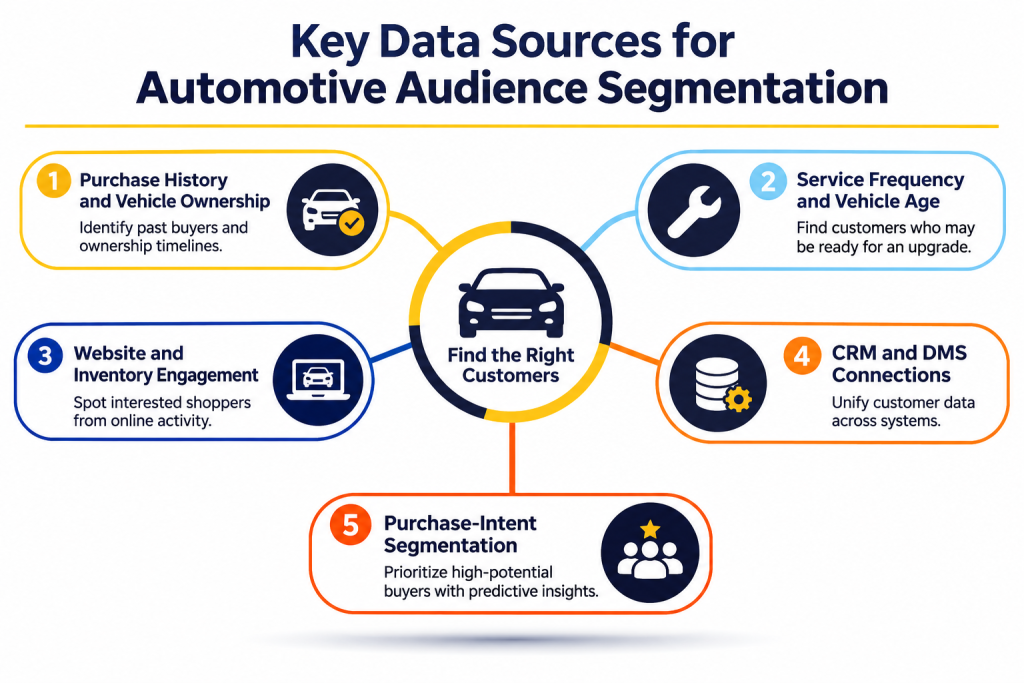
Start with five areas:
- Purchase history and vehicle ownership: Review previous purchases, vehicle models, and ownership timelines to identify potential replacement audiences.
- Service frequency and vehicle age: Examine repair patterns, mileage, and vehicle age to identify customers who may benefit from a replacement conversation.
- Website and inventory engagement: Identify repeat visitors and customers engaging with specific vehicle categories or inventory pages, where this activity can be reliably connected to customer records.
- CRM and DMS connections: Bring relevant sales, service, and customer information together to create a more complete customer profile.
- Purchase-intent segmentation: Group customers according to relevant behavioral and ownership signals rather than relying only on broad demographic categories.
The importance of connecting dealership data is reinforced by Cox Automotive’s July 2024 Power of Data Study. Its research highlighted how data delays and fragmentation limit dealers’ ability to turn information into useful insights.
The takeaway is straightforward: customer information becomes more valuable when dealerships can connect it, interpret it, and act on it.
Use AI to Discover Audiences Your Dealership May Be Missing
Traditional segmentation uses fixed criteria such as vehicle ownership, purchase date, and customer status. AI and predictive analytics combine multiple signals to identify potential buying intent.
For example, an older vehicle, frequent service visits, and interest in another vehicle category may indicate an opportunity for an upgrade or trade-in campaign.
AI can support this process in four ways:
- Predictive analytics: Analyze available customer and vehicle information to identify potential replacement opportunities.
- AI-assisted segmentation: Group customers according to shared ownership patterns, service activity, and engagement signals.
- Propensity scoring: Prioritize customers based on their estimated likelihood of taking a particular action.
- Cross-selling and upgrade identification: Discover opportunities to introduce relevant vehicle categories, upgrades, or dealership services.
Cox Automotive’s December 2024 announcement about its VinSolutions AI solution illustrates this direction. It discusses using first-party behavioral data and AI-driven insights to help dealerships identify potential buyers.
However, AI should support better decisions, not replace sales judgment. Predictions are estimates, not guarantees of buying intent. Customer consent, data accuracy and human review remain essential.
Turn Audience Insights into Targeted Dealership Campaigns
Identifying an audience is only the beginning. Dealerships need to turn those insights into relevant customer interactions.
Once high-potential segments are identified, CRM and marketing automation can help coordinate personalized campaigns and timely sales follow-ups.
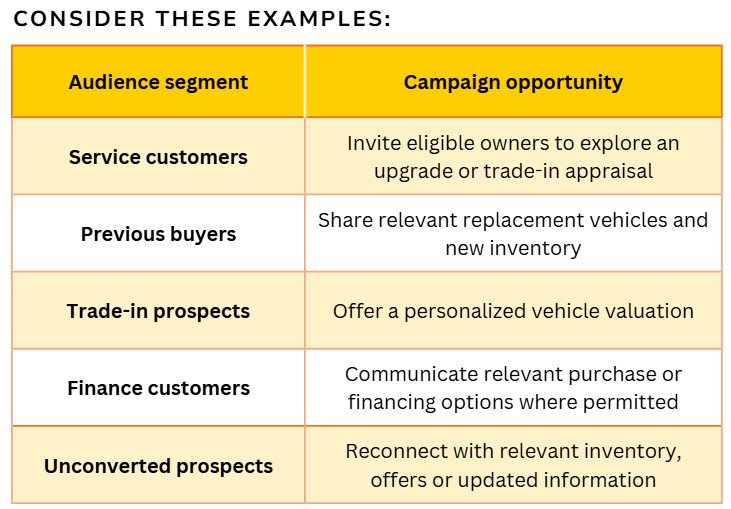
The objective is not to send more promotional messages. It is to make each interaction more relevant to the customer’s circumstances.
For example, a customer who recently visited the service department for a major repair may respond better to a trade-in assessment than a generic new-vehicle promotion.
Similarly, a previous buyer may be more interested in a replacement model that matches their ownership history than an unrelated inventory announcement.
First-party data supports this shift toward more relevant customer engagement. WardsAuto’s May 2025 article, Omnichannel, First-Party Data Top Automotive Marketing Trends in 2025, discusses the growing importance of first-party data and personalized automotive marketing.
Measure Audience Quality Through Sales Outcomes
A larger audience does not necessarily mean better marketing performance.
Dealerships need to understand whether data-driven audience discovery generates qualified inquiries, showroom visits, and vehicle sales.
Track these five measurements:
- Qualified audience size: How many customers meet the selected segment criteria?
- Campaign-to-inquiry conversion: How many customers respond with a relevant sales inquiry?
- Appointment and showroom visit rates: How many campaign responses lead to scheduled appointments and actual visits?
- Sold units by customer segment: Which audiences generate completed vehicle sales?
- Revenue and acquisition cost by segment: How much revenue does each audience generate, and what does it cost to activate and convert that audience?
It is also important to compare results against existing acquisition campaigns.
For example, does a service-to-sales campaign generate additional vehicle sales compared with a traditional paid advertising campaign? Are previous customers converting at a different rate from newly acquired leads?
These comparisons help dealership leaders understand where their marketing investment creates measurable business value.
Your Next Buyer May Already Be in Your Customer Database
Dealership growth doesn’t have to rely only on finding more in-market shoppers. Your existing database may already contain upgrade opportunities, previous buyers nearing replacement, trade-in prospects, and leads ready to reconsider.
By connecting CRM, DMS, sales, service, and finance data, dealerships can use AI-powered analytics and marketing automation to identify these opportunities and turn them into targeted campaigns and relevant sales conversations.
Discover the Buyers Your Dealership May Be Missing
Marmato Digital helps dealerships move from broad audience targeting to data-driven customer acquisition through CRM consulting, AI strategy, data analytics, RevOps, and marketing automation.
Discover which customer segments your dealership may be overlooking.
Book a consultation with Marmato Digital to explore AI-powered audience discovery and customer data activation.
LET’S CONNECT AT NADA 2027!
Let’s discuss how AI, CRM, and automation can improve dealership performance and drive revenue growth.
Subscribe to Newsletter
Get our latest blogs directly to your inbox.


