

Your dealership may be generating clicks and hundreds of leads, but how many translate into showroom visits and vehicle sales?
Cox Automotive’s July 2025 research found that 92% of vehicle sales in its study were untraceable in dealership CRM systems, highlighting a gap between marketing activity and actual sales outcomes.
The answer isn’t always more advertising. It’s connecting marketing, CRM, and sales data to identify opportunities, improve conversions, and measure what drives revenue.

Building a Dealership Digital Marketing Funnel That Drives Sales
Your dealership doesn’t need more leads that never make it to the showroom. It needs a strategy that turns vehicle interest into appointments, test drives, and completed sales.
A digital marketing funnel for car dealerships connects every stage of the buyer journey, from online vehicle discovery to showroom visits, financing, and purchases.
By bringing together customer data, inventory, CRM, marketing automation, and sales processes, dealerships can identify high-intent buyers, improve lead conversion, and turn marketing activity into measurable outcomes: more showroom visits, more vehicle sales, and stronger revenue growth.
Understanding the Modern Car Dealership Marketing Funnel
A modern digital marketing funnel for car dealerships must connect every customer interaction, from the first online search to the showroom visit, purchase, and future service engagement.
Instead of treating marketing as a lead-generation activity, dealerships should build a connected click-to-showroom funnel.
The Click-to-Showroom Funnel
- Audience Discovery: Identify in-market shoppers, existing customers, service customers, and potential trade-in buyers.
- Awareness and Vehicle Discovery: Connect shoppers with relevant inventory, vehicle information, offers, and dealership experiences.
- Consideration and Engagement: Understand vehicle preferences, financing interests, trade-in intent, and purchase timelines.
- Lead Qualification and Nurturing: Identify high-intent prospects and deliver relevant follow-ups based on their interactions.
- Showroom Visit and Test Drive: Convert online engagement into scheduled appointments, dealership visits, and test drives.
- F&I and Vehicle Purchase: Connect financing discussions, trade-in opportunities, and sales activities to complete the purchase journey.
- Retention and Repeat Revenue: Continue engaging customers through service reminders, vehicle upgrade campaigns, and relevant ownership communications.
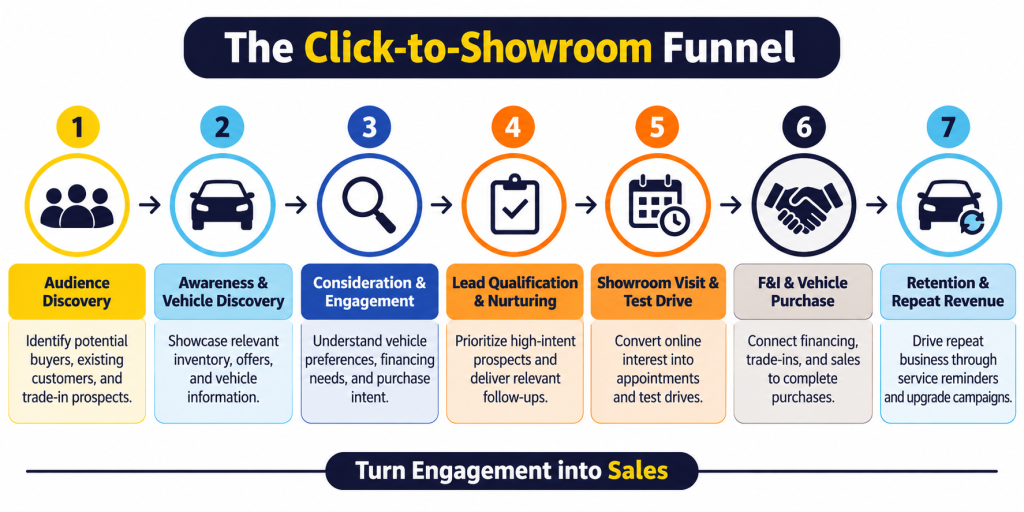
Each stage should provide useful information to the next. When these interactions are connected, dealerships can better understand where buyers are progressing and where potential sales are being lost.
Cox Automotive’s 2025 Car Buyer Journey Study highlights the importance of connected digital and in-person experiences. Its January 2026 findings show that 63% of buyers consider an omnichannel approach ideal, combining online convenience with dealership interactions.
Stop Competing for the Same Buyers: Discover Untapped Audiences
Your next vehicle sale may already be within your dealership’s existing customer database.
Many dealerships concentrate their marketing efforts on acquiring new prospects while overlooking valuable opportunities among existing customers.
Consider these potential audiences:
- Service customers: Owners approaching a vehicle replacement decision or experiencing increasing maintenance needs.
- Previous buyers: Customers who may be approaching an upgrade or replacement cycle.
- Financing customers: Buyers approaching relevant financing milestones who may be interested in another vehicle.
- Trade-in prospects: Customers whose vehicle ownership history or trade-in inquiries indicate potential upgrade interest.
- Unconverted prospects: Shoppers who previously explored inventory or requested financing information but did not complete a purchase.
The challenge is identifying these opportunities at the right time.
Dealership CRM, sales, service, and F&I data can help reveal customer interests and potential buying signals. Instead of sending the same promotional message to everyone, marketing teams can build more relevant audience segments.
This creates an opportunity to generate additional sales conversations without relying entirely on new advertising spend.
Optimize Every Stage of the Digital Marketing Funnel
Generating the right audience is only the beginning. Dealerships must ensure that every interaction moves potential buyers closer to a purchase.
A connected automotive digital marketing strategy should focus on five areas:
- Inventory-aligned advertising: Ensure that advertisements and landing pages reflect available vehicles, relevant offers, and accurate inventory information.
- Vehicle-specific content: Provide useful specifications, comparisons, images, videos, and financing information to support purchase decisions.
- Connected lead management: Integrate lead forms with CRM and marketing automation platforms to capture customer information and trigger appropriate follow-ups.
- Faster lead response: Improve lead routing and establish timely communication between marketing and sales teams.
- Appointment conversion: Coordinate follow-ups, test-drive scheduling, and showroom appointments to reduce friction between online interest and dealership visits.
The objective is to create a consistent experience across marketing, sales, and dealership operations.
Cox Automotive’s 2025 GfK Content Influence Study reports that 92% of new-car shoppers use content during their research, while 42% first discover the vehicle they ultimately choose through content. This highlights the importance of relevant vehicle content throughout the buying journey.
Connect Sales, Service, Trade-In, and F&I Data
A dealership’s customer information is often distributed across different systems and departments.
Marketing may track campaign engagement, sales teams manage vehicle inquiries, service departments maintain repair histories, and F&I teams handle financing interactions.
When these systems operate independently, customer insights remain fragmented.
Connecting this information creates a more complete customer profile and helps dealerships identify opportunities across departments.
For example:
- Service records can help identify customers who may be approaching a vehicle replacement decision.
- Trade-in information can support targeted upgrade campaigns.
- F&I interactions can provide useful context about financing preferences and future purchase opportunities.
- Sales history can help identify previous buyers who may be suitable for relevant vehicle upgrade communications.
This approach also supports better customer experiences.
J.D. Power’s 2025 U.S. Customer Service Index (CSI) Study highlights the relationship between dealership service experiences and customer loyalty. It identifies communication, keeping customers informed about service status, and addressing customer needs as important satisfaction drivers.
For dealerships, this reinforces the importance of maintaining meaningful customer relationships beyond the initial vehicle purchase.
Bring AI into the Dealership Digital Marketing Funnel
AI can help dealerships move from reactive marketing activities to more informed customer engagement.
However, its value depends on the quality of customer data, connected systems, and clearly defined business processes.
Practical applications include:
- AI audience discovery: Analyze available customer and engagement data to identify potentially valuable audience segments.
- Predictive lead scoring: Prioritize prospects using relevant buying signals, inquiry history, and engagement patterns.
- AI-assisted personalization: Support relevant vehicle recommendations, campaign content, and customer follow-ups.
- Marketing automation: Trigger communications based on customer actions, such as vehicle inquiries, financing interest, or service milestones.
- AI-powered analytics: Identify funnel bottlenecks, compare campaign performance, and highlight potential conversion opportunities.
For example, when a customer repeatedly explores a specific vehicle category and requests financing information, connected systems can help the dealership recognize that interest and prioritize an appropriate sales follow-up.
Cox Automotive’s 2025 Car Buyer Journey Study, published January 2026, found that 25% of new-vehicle buyers engaged with AI tools during their shopping process. It also reported that 84% of mostly digital buyers who engaged with AI assistants were highly satisfied with their overall buying experience.
The findings demonstrate the growing relevance of AI and digital tools in automotive retail. For dealerships, the opportunity is to apply these technologies to improve customer engagement and operational efficiency.
Measure What Matters: From Clicks to Sold Units
A successful car dealership marketing funnel should measure performance beyond campaign engagement.
Marketing, sales, and revenue metrics must work together to show how digital interactions contribute to actual business outcomes.
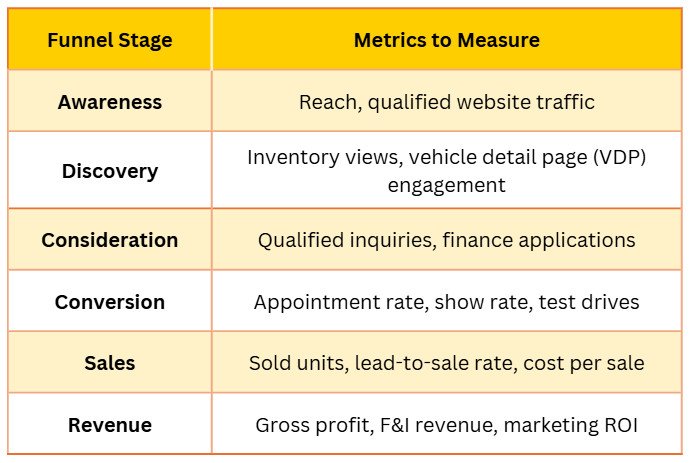
These metrics help dealership leaders identify where performance is strong and where improvements are needed.
For example, high vehicle detail page engagement but low appointment rates may indicate a gap in the consideration or follow-up process.
Similarly, a high volume of inquiries with a low lead-to-sale rate may point to lead quality, response times, or sales process challenges.
The goal is to connect marketing activity with dealership sales performance and understand which investments contribute to revenue.
Building a Connected, Sales-Driven Dealership Marketing Strategy
Building a sales-driven marketing funnel requires more than adding another marketing platform or AI tool.
Dealerships need a clear strategy that connects technology, customer data, and business processes.
Start with five priorities:
- Audit existing systems: Review marketing platforms, CRM, inventory management, and customer data sources.
- Connect customer information: Improve visibility across marketing, sales, service, and F&I interactions.
- Identify conversion gaps: Evaluate where prospects disengage between vehicle discovery, inquiry, appointment, and purchase.
- Introduce AI and automation: Apply technology to specific challenges such as audience segmentation, lead qualification, follow-ups, and reporting.
- Establish revenue-focused reporting: Build dashboards that connect campaign performance with appointments, sold units, and revenue outcomes.
Stop Counting Leads. Start Measuring Cars Sold.
Digital marketing success should not end with a click, an inquiry, or a completed lead form.
For automobile dealerships, the real measure of marketing performance is its contribution to showroom visits, vehicle purchases, customer retention, and revenue growth.
The opportunity may not always require a bigger advertising budget. It may require better visibility into existing customer data, stronger connections between dealership systems, and more effective engagement throughout the buying journey.
Is your dealership measuring clicks or actual vehicle sales?
By connecting marketing technology, customer information, and sales processes, dealerships can develop a more measurable and efficient approach to customer acquisition and retention.
Marmato Digital helps dealerships bring these elements together through AI Strategy & Advisory, CRM Consulting, Marketing Automation, Data & Analytics, and Business Process Automation.
Book a consultation with Marmato Digital to identify opportunities to connect your dealership’s marketing funnel, CRM, customer data, and sales processes with measurable revenue outcomes.
LET’S CONNECT AT NADA 2027!
Let’s discuss how AI, CRM, and automation can improve dealership performance and drive revenue growth.
Subscribe to Newsletter
Get our latest blogs directly to your inbox.


