Modern marketing automation depends on data quality. Even advanced campaigns, lead scoring models, and AI-driven personalization can fail when built on inaccurate or outdated information. While many organizations rely on occasional cleanup projects, lasting success requires a scalable data cleansing framework that continuously monitors, standardizes, and improves data quality over time.

Why Data Cleansing Matters in Marketo?
Marketing automation platforms rely on accurate customer data. When data quality declines, the impact spreads across the entire revenue engine.
Common data quality problems in Marketo include duplicate lead records, invalid email addresses, inconsistent field values, missing information, and CRM synchronization conflicts.
These issues often originate from manual imports, multiple form submissions, third-party enrichment tools, poor CRM governance, and API integrations without validation rules.
Business Impact of Dirty Data:
Dirty data creates operational and financial problems that directly affect marketing and sales performance.
- Reduced Campaign Effectiveness:
Segmentation becomes unreliable when field values are inconsistent. Personalization tokens fail when important fields are blank or inaccurate.
For example, “United States,” “USA,” and “US” may split audiences incorrectly.
- Poor Sales and Marketing Alignment:
Sales teams lose trust in marketing-generated leads when records contain duplicate or outdated information. This leads to slower follow-up times, incorrect lead ownership, CRM confusion, and reduced conversion rates.
- Inaccurate Reporting and Attribution:
Dirty data affects funnel reporting, revenue attribution, lead scoring accuracy, and lifecycle conversion analysis. Executives may make strategic decisions based on inaccurate reports.
- AI and Automation Failures:
AI systems are based on the data they consume. Poor-quality data negatively impacts predictive scoring models, AI-driven segmentation, personalization engines, and intent-based marketing strategies.
What Is a Scalable Data Cleansing Framework?
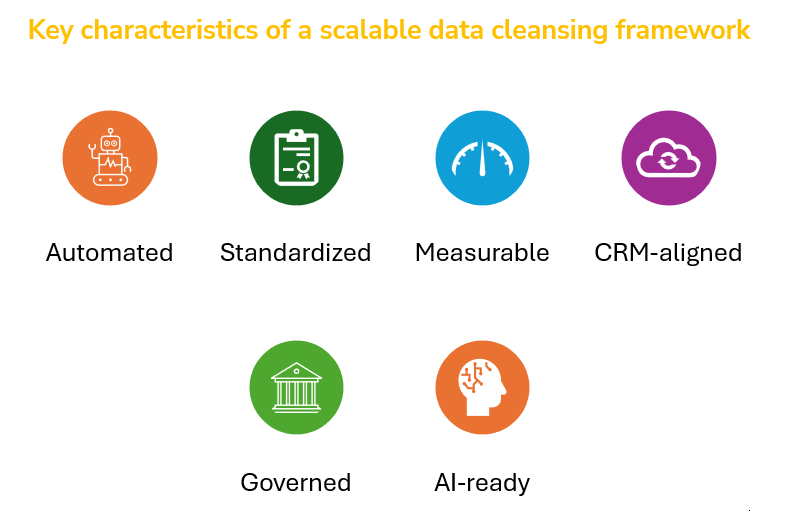
A scalable data cleansing framework is a structured system that continuously improves data quality through governance, automation, monitoring, and operational processes.
Unlike one-time cleanup projects, scalable frameworks focus on prevention and long-term sustainability. The goal is to reduce manual intervention while maintaining consistent data quality as the database grows.
Step 1: Establish Data Governance Standards
Data cleansing starts with governance. Without clear standards, data quality problems will continue to reappear.
- Define data ownership and assign responsibilities across teams to ensure data accuracy.
- Create standardized field rules and define required fields, accepted field formats, dropdown value standards, naming conventions, and lifecycle stage definitions.
- Develop governance documentation to list down field definitions, data entry rules, CRM sync logic, lead lifecycle stages, and data retention policies to reduce operational confusion.
Step 2: Audit Your Existing Marketo Database
Before building automation, conduct a Data Health Assessment.
- Review duplicate rates, invalid email percentages, missing critical fields, database growth trends, and sync failures to create a baseline for future improvement measurements.
- Prioritize areas that frequently introduce poor-quality data, such as purchased lists, event imports, legacy CRM migrations, webinar registrations, and third-party integrations.
- Benchmark key metrics such as bounce rate, MQL-to-SQL conversion rate, and unsubscribed contacts to measure the effectiveness of your cleansing framework over time.
Step 3: Standardize and Normalize Data
Data normalization ensures consistent formatting across records.
- Normalize critical fields such as job titles, industries, countries, states, company names, and phone numbers.
- In Marketo, use Smart campaigns, Batch campaigns, Operational workflows, Segmentation logic, and Tokens to create automated workflows and standardize incoming values in real time.
- Build controlled taxonomies for regions, company sizes, industries, and lifecycle stages to prevent uncontrolled field variations from spreading across the database.
Step 4: Implement Automated Deduplication
Duplicate records are one of the most damaging data quality issues in Marketo environments.
- Duplicates commonly result from multiple form submissions, CRM sync delays, different email aliases, manual imports, and event platform integrations.
- Create Deduplication Rules based on email addresses, name + company combinations, CRM IDs, and domain matching.
- Automate Deduplication Processes and build Trigger-based workflows, Scheduled batch cleanups, merge request queues, and Operational alerts.
- Prevent Duplicate Creation by implementing Form validation rules, Progressive profiling, CRM validation controls, and API-level duplicate checks.
Step 5: Create Lifecycle-Based Retention Policies
Not all records should remain in your database forever.
- Categorize records into Active leads, Engaged prospects, Dormant contacts, Disqualified records, and Inactive subscribers to prioritize cleanup efforts.
- Build Retention Rules for Archiving, Deletion, Re-engagement campaigns, and Compliance-related removal.
- Retention policies help reduce storage costs, improve campaign performance, increase sync efficiency, and simplify segmentation.
Step 6: Automate Ongoing Data Quality Monitoring
Data cleansing should be continuous, not reactive.
- Create Automated Monitoring Systems using smart lists, scheduled reports, alert campaigns, and dashboard tracking that detect missing fields, invalid values, duplicate spikes, sync failures, and bounce increases.
- Monitor Data Quality KPIs, including duplicate growth rate, invalid email percentage, field completion rates, sync error counts, and deliverability trends, to identify issues before they affect campaigns.
Step 7: Align Marketo with CRM
Marketo data quality cannot exist in isolation.
- Ensure Cross-System Consistency. Misalignment between systems creates ongoing data conflicts.
- Build a shared governance model for Marketing, Sales, and RevOps teams to collaborate on Data standards, Lead routing logic, Attribution models, and reporting definitions.
Step 8: Prepare Your Data for AI and Advanced Personalization
As AI adoption increases, clean data becomes even more important.
- AI systems depend on structured datasets, accurate historical activity, consistent field values, and reliable engagement signals.
- Poor data quality weakens predictive scoring, personalization engines, AI-generated insights, and audience targeting.
- Build an AI-Ready Data foundation to be better positioned for future AI-driven marketing strategies.
Common mistakes to avoid:
- Treating Cleansing as a One-Time Project: Data quality is an ongoing operational process, not a quarterly task.
- Over-Automating Without Governance: Automation without standards can spread bad data faster.
- Ignoring CRM Alignment: Inconsistencies between Marketo and CRM systems often create recurring data problems.
- Deleting Valuable Historical Data: Not all inactive data should be removed immediately. Some records remain valuable for reporting and attribution analysis.
Conclusion:
Building a scalable data cleansing framework in Marketo requires more than occasional cleanup campaigns. It demands a long-term strategy built on governance, automation, monitoring, and cross-functional collaboration.
Organizations that invest in structured data quality processes gain:
- Better campaign performance
- More accurate reporting
- Higher sales productivity
- Improved deliverability
- Stronger AI readiness
- Lower operational costs
In today’s data-driven marketing environment, clean data is the foundation of scalable marketing operations and sustainable revenue growth.
Looking to optimize your Marketo data quality strategy?
A scalable data cleansing framework is essential to improving campaign performance. Marmato Digital can help you implement standardized validation rules, automated deduplication processes, regular database audits, and strong data governance practices. We can also help you reduce operational inefficiencies and build a healthier marketing database. Contact us today to build a scalable data-cleansing framework that improves lead management, personalization, and long-term marketing success.
Subscribe to Newsletter
Get our latest blogs directly to your inbox.