

A customer explores vehicles on your dealership website and submits an inquiry. But does your sales team respond quickly, share relevant information, and follow up?
For dealerships, the challenge is not just generating leads. It is turning inquiries into conversations, showroom visits, and sales.
Today’s buyers use websites, automotive marketplaces, social media, and AI tools to research vehicles. Cox Automotive’s August 2026 research found that 63% of in-market vehicle shoppers are likely to use AI during their next vehicle purchase journey.
This creates an opportunity for dealerships to connect customer data, CRM, AI, and marketing automation to improve follow-ups and deliver personalized vehicle recommendations.
The goal: Turn every inquiry into an opportunity to build a customer relationship and generate a sale.
Your Dealership Is Generating Leads. But Are You Converting Them?
Why Dealerships Are Losing Opportunities After Receiving Leads
A vehicle inquiry does not guarantee a showroom visit. Customers often compare prices, explore financing options, and contact multiple dealerships before deciding.
Without timely responses and relevant follow-ups, dealerships risk losing potential buyers to competitors.
The 2026 Foureyes Automotive Dealer Benchmarks Report highlights the scale of this lead conversion challenge.
The report analyzed 1.4 billion dealership website visits, approximately 32 million inventory records, and more than 22,900 dealership websites. It found that:
- 42.7% of qualified leads were mishandled.
- 15.2% of qualified leads were never logged in the CRM.
These findings point to problems with lead tracking, response times, and sales follow-up.
Common dealership lead management challenges include:
- Delayed responses to vehicle inquiries.
- Missed website forms, chat conversations, and phone calls.
- Customer information spread across disconnected systems.
- Generic follow-up messages that do not address buyer interests.
- No clear visibility into whether an inquiry resulted in a showroom visit.
- Missed opportunities to reconnect with customers who continue researching vehicles.
Increasing advertising spend will not automatically solve these problems.
Dealerships need a better way to capture, organize, and act on customer information.
AI-Powered Lead Engagement: Respond Before Buyers Move On
Timely responses can make the difference between winning and losing a vehicle inquiry. Customers often contact multiple dealerships, making quick and relevant engagement essential.
Invoca’s 2026 Automotive Buyer Experience Report found that negative experiences with AI interactions declined from 23% to 17% year over year.
As AI becomes more familiar to automotive buyers, dealerships can use AI and marketing automation to respond faster, engage prospects, and improve lead conversion.
How AI can support dealership lead engagement
- Instant inquiry responses: Acknowledge incoming inquiries and provide initial information about vehicle features and availability.
- Automated lead qualification: Collect information about vehicle preferences, budget, purchase timeline, and financing interest.
- Personalized follow-ups: Send relevant emails or text messages based on the customer’s inquiry and engagement.
- Appointment scheduling: Help customers request showroom visits and test drives.
- After-hours engagement: Capture inquiries and provide initial assistance outside regular dealership hours.
For example, imagine a customer submitting an inquiry about a new SUV at 9 PM.
Instead of waiting until the next business day for an acknowledgment, an AI assistant could respond, collect the customer’s preferred contact time, and help arrange a test drive.
A sales representative can then take over to discuss vehicle availability, pricing, and other purchase details.
The important point: AI should support dealership employees, not replace the personal interaction customers need when making a major purchase.
CRM and RevOps: Connect Marketing and Sales to Improve Conversions
Generating leads through advertising, dealership websites, and automotive marketplaces is only the first step.
The next challenge is making sure every inquiry reaches the right person and receives appropriate follow-up.
This is where CRM and Revenue Operations (RevOps) become important.
A dealership CRM should help sales representatives understand customer interactions, including:
- Vehicle inquiries and website activity.
- Customer contact information.
- Preferred vehicle models and features.
- Previous sales conversations.
- Follow-up activities and appointment status.
- Test drive and purchase progress.
When this information is spread across different systems, sales representatives may not have the complete context needed to engage customers.
For example, a customer may submit a website inquiry, contact the dealership through chat, and later call the sales team.
Without connected systems, these interactions may be treated as separate inquiries.
A connected CRM process helps bring these interactions together.
How RevOps improves dealership lead management
RevOps connects marketing, sales, and customer data around a shared revenue process.
For dealerships, this means:
- Marketing captures inquiries: Leads from paid advertising, website forms, automotive marketplaces, and other channels enter the CRM.
- Sales receives assigned leads: Inquiries reach the appropriate sales representative or business development team.
- Automated follow-ups begin: Customers receive relevant communication based on their interests and engagement.
- Sales tracks progress: Representatives record conversations, update lead statuses, and schedule appointments.
- Management measures results: Dealership leaders monitor response times, appointment bookings, showroom visits, and completed sales.
McKinsey’s 2025 automotive retail research highlights the importance of integrating CRM systems, omnichannel engagement tools, and AI rather than relying on disconnected technology solutions. It also identifies technology integration and employee productivity as important challenges for auto retailers.
This is why dealerships need more than a CRM that simply stores contact information.
They need connected processes that help employees act on customer information.
The opportunity: When marketing and sales share customer data and performance metrics, dealerships can identify where leads are getting stuck and improve the process before potential buyers move elsewhere.
Personalized Vehicle Recommendations: Turn Customer Data into Relevant Offers
Today’s car buyers have different priorities.
One customer may be looking for a fuel-efficient sedan. Another may need a family SUV with advanced safety features. Someone else may be comparing electric vehicles based on driving range and charging requirements.
Sending the same promotional message to all these customers is unlikely to address their individual needs.
Dealerships can improve customer engagement by using customer information and vehicle data to personalize recommendations.
Cox Automotive’s 2026 research on AI-powered vehicle discovery explains how shoppers increasingly ask AI tools questions about vehicle features, pricing, and availability rather than simply browsing lists of vehicles.
This makes accurate and detailed inventory information increasingly important.
What customer data can dealerships use?
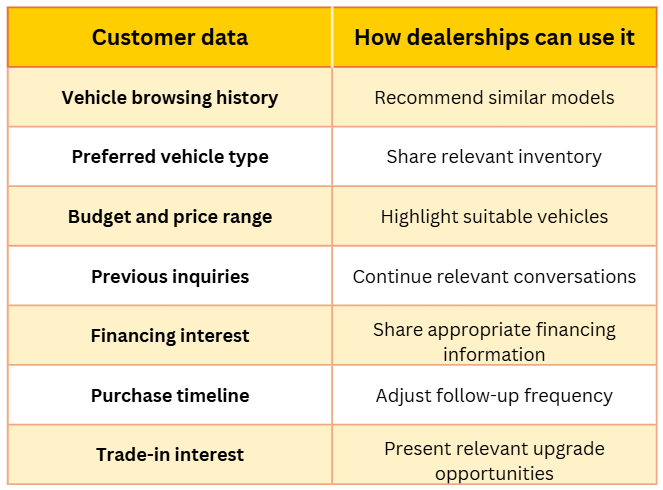
For example, imagine a customer who repeatedly visits your website to explore midsize SUVs.
Instead of sending a generic promotional email, your dealership could share:
- Available SUVs within the customer’s preferred price range.
- Comparisons of relevant models and features.
- Information about fuel economy and safety features.
- An invitation to schedule a test drive.
Marketing automation can deliver these messages based on customer activity and preferences. AI can help analyze available information and identify relevant vehicle options.
Don’t overlook your existing customer database
Personalization is not limited to new website inquiries.
Dealerships already have valuable information in their CRM and Dealer Management System (DMS).
Past purchases, service visits, lease information, and customer interactions can help identify potential buyers.
For example:
- A customer approaching the end of a lease may be interested in another vehicle.
- A previous buyer may be interested in a newer version of their current model.
- A customer who has expressed trade-in interest may be a potential upgrade opportunity.
The key is to connect relevant customer information with timely, appropriate communication.
Make the Journey from Online Inquiry to Showroom Visit Easier
Converting an inquiry into a showroom visit is the next step in the sales journey. Today’s buyers expect convenient digital experiences alongside personal assistance.
Cox Automotive’s 2026 Car Buyer Journey Study found that buyer satisfaction reached a record high in 2025, highlighting the value of digital tools, AI, and connected retail experiences.
Dealerships can use these tools to connect online engagement with in-person sales opportunities.
Five ways to encourage showroom visits
- Provide relevant vehicle information: Share accurate inventory details, pricing information, and available features.
- Offer convenient appointment scheduling: Give customers an easy way to request a showroom visit or test drive.
- Send personalized reminders: Follow up with customers who have shown interest but have not booked an appointment.
- Prepare sales representatives: Share inquiry history and vehicle preferences with the assigned representative before the customer arrives.
- Continue communication after the visit: Follow up with customers who completed a test drive but have not made a purchase decision.
Podium highlights five key stages of automotive lead management: capture, consolidation, routing, response, and follow-up. Managing all five helps create a smoother journey from online research to showroom visits.
Measure What Matters: Track the Entire Dealership Lead Conversion Journey
Many dealerships measure marketing performance through the number of leads generated.
However, lead volume alone does not show whether marketing investments are producing vehicle sales.
A dealership may generate hundreds of inquiries but still struggle to bring customers into the showroom.
To understand where opportunities are being lost, dealerships need to measure performance across the customer journey.
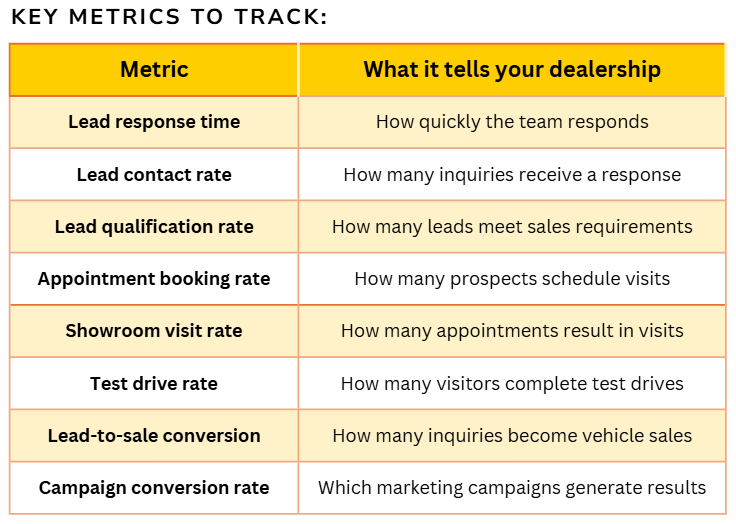
Invoca’s 2026 Automotive Lead Conversion Benchmarks Report found that:
- 58% of callers to automotive businesses speak with a person.
- 53% of calls from digital marketing are leads.
- 45% of those leads convert during the call.
- 64% of automotive businesses do not ask leads to buy or book an appointment.
These findings highlight the importance of measuring more than incoming calls and inquiries.
Dealerships should understand what happens after a customer makes contact.
By connecting CRM data, marketing campaign information, and sales outcomes, management can identify:
- Which marketing channels generate qualified buyers.
- Which campaigns generate showroom appointments.
- Where customers drop out of the buying journey.
- Which follow-up activities improve engagement.
- Which sales processes need improvement.
This gives dealership leaders a clearer picture of marketing performance and sales opportunities.
Is Your Dealership Ready for AI-Powered Lead Conversion?
AI and marketing automation are creating new opportunities for automotive retailers. However, implementing new technology without reviewing existing processes can create more complexity.
Before investing in new tools, dealerships should evaluate their current lead management and customer engagement processes.
Consider these questions:
- Are all website, phone, chat, and marketplace inquiries captured in your CRM?
- Can your sales team access a complete history of customer interactions?
- Are leads receiving timely responses, including after business hours?
- Do your follow-up messages reflect customer interests and vehicle preferences?
- Can your CRM help identify potential buyers within your existing customer database?
- Can you track the journey from initial inquiry to showroom visit and completed sale?
- Are marketing and sales teams working with shared performance metrics?
If several of these questions are difficult to answer, your dealership may have gaps in its lead conversion process.
The solution may not require more advertising or another standalone technology platform.
It may require better integration between your existing CRM, marketing automation, customer data, and sales processes.
Conclusion:
Generating leads is only the first step. Dealerships need AI, connected CRM processes, and personalized communication to turn inquiries into showroom visits and sales.
The real opportunity is not generating more leads but converting more of the leads you already have.
Ready to Turn More Dealership Inquiries into Sales?
Your dealership may already have the customer data, CRM, and marketing platforms needed to improve lead conversion. The challenge is making them work together.
Marmato Digital helps automotive businesses connect marketing technology, CRM, AI, and revenue operations to improve customer engagement and business outcomes.
Book a consultation with Marmato Digital to assess your dealership’s lead management process, identify conversion gaps, and explore opportunities to use AI and marketing automation more effectively.
Turn more inquiries into conversations. More conversations into showroom visits. And more opportunities into car sales.
LET’S CONNECT AT NADA 2027!
Let’s discuss how AI, CRM, and automation can improve dealership performance and drive revenue growth.
Subscribe to Newsletter
Get our latest blogs directly to your inbox.


