AI agents are becoming part of how businesses sell, market, and serve customers. But before scaling AI, executives should ask:
Does the AI agent have enough trusted customer data to make useful decisions?
If data is incomplete or spread across disconnected systems, AI agents may struggle to deliver reliable results. This is where Data 360 can play an important role.
What Is Data 360?
Data 360, formerly known as Data Cloud, is Salesforce’s data platform for connecting, harmonizing, unifying, and activating data from different sources. It helps provide AI solutions with trusted, relevant data. For businesses, the goal isn’t just to connect data, but to give AI agents the customer context they need to support better experiences and decisions.
The Customer Context Problem:
Consider a customer who contacts a company about a product issue.
The service agent may have access to the current case, but useful context could also exist in:
- Customer profile and account data
- Previous service interactions
- Purchase and order history
- Marketing engagement
- Sales activity
- Product information
- Emails, chat transcripts, or case notes
When these sources are disconnected, an AI agent may have limited information.
Data 360 brings these data sources together, including both structured and unstructured data. It can also use identity resolution to create unified profiles by linking customer information from different sources.
The goal is simple: give the AI agent more relevant context before it responds or acts.
How does Data 360 create Context for AI Agents?
The process can be viewed as five key steps:
- Connect Data:
Data 360 can connect data from Salesforce and external sources, including structured and unstructured data. Salesforce also supports zero-copy data federation for certain data sources.
Example:
Customer records + orders + service cases + marketing engagement + external data.
- Harmonize the Data:
Data from different systems may use different structures and formats. Data 360 can map and harmonize data to a standard data model.
This creates a more consistent foundation for downstream analysis and AI use cases.
- Unify Customer Identities:
A customer may appear differently across systems. Identity resolution helps link source profiles into unified profiles based on configured rules.
For example:
CRM: John Smith
Commerce: J. Smith
Service: John S.
Instead of treating these as unrelated records, identity resolution can help establish their relationship within a unified profile.
- Bring in Unstructured Information:
Important customer context does not always exist in database fields.
It can be found in:
- Emails
- Chat transcripts
- Case notes
- Documents
- Call transcripts
- Knowledge articles
- Customer feedback
Salesforce says Data 360 can use unstructured data to ground Agentforce and other AI use cases. Its search and retrieval capabilities can help agents access relevant information when responding to a request.
- Ground the AI Agent:
Once relevant data is connected and prepared, Data 360 can provide context for Agentforce agents. Salesforce describes this as grounding agents with trusted, relevant data so they can use business-specific information in their responses and actions.
A Simple Data 360 + AI Agent Workflow:
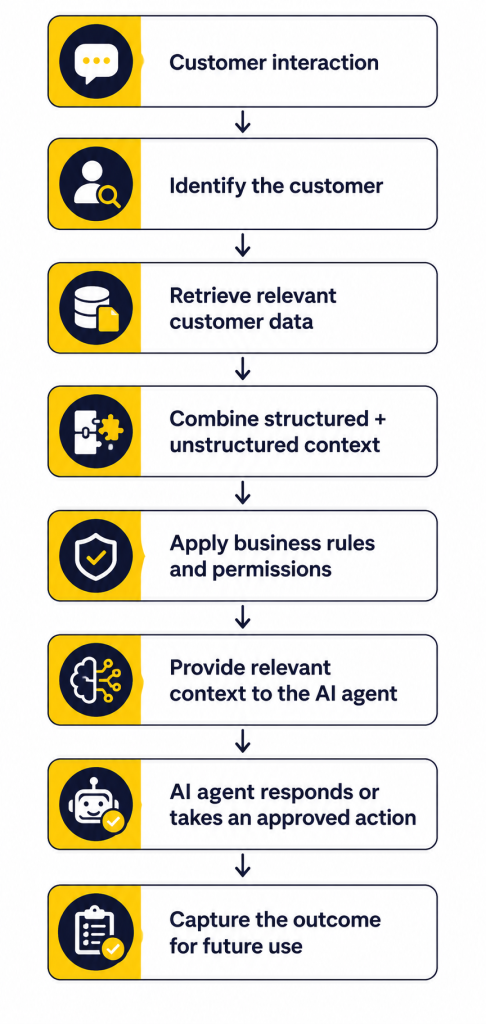
The key point is that Data 360 isn’t simply giving the agent more data. It is helping make relevant data available in a form the agent can use.
Data 360 Business Cases:
Business Case 1: AI-Powered Service
Imagine a customer contacts support about a product problem.
Without broader context, the AI agent may see only the current service case.
With connected customer context, the agent could have access to relevant information such as previous cases, purchase information, emails, and knowledge content, depending on the organization’s implementation and permissions.
Salesforce gives a similar example: Data 360 supports Agentforce Service by providing information such as past emails, support tickets, product photos, and voicemails.
Business value: Reduce context gaps and help service teams deliver more relevant customer interactions.
Business Case 2: AI-Assisted Sales
Sales teams often work with information spread across CRM records, emails, meeting notes, call transcripts, and other systems.
Data 360 can bring structured and unstructured information together for AI use cases. Salesforce specifically describes sales scenarios where agents can use emails, call transcripts, and notes to create more detailed meeting briefings and summaries.
Business value: Sales teams can spend less time gathering information manually and more time preparing for customer conversations.
Business Case 3: More Personalized Customer Engagement
Marketing teams can also use unified customer data to create segments and activate personalized experiences. Data 360 supports segmentation and activation using unified data.
For example, an organization could combine customer profile information with engagement and transaction data to create more relevant audiences.
The key opportunity is to move from isolated campaign data to a broader customer view.
Why Data Quality Still Matters?
Data 360 does not automatically solve every data problem.
Connecting more data does not necessarily mean the data is accurate, complete, or appropriate for every AI use case. Salesforce itself describes Data 360 as a foundation for trusted data and notes that organizations may use additional data-management capabilities alongside it.
For organizations preparing AI agents, this means addressing the data foundation alongside the AI strategy.
Key areas include:
- Data quality
- Identity resolution
- Data governance
- Access and permissions
- Relevant data selection
- Data freshness
- Clear business rules
Better AI starts with better context, but better context starts with usable, governed data.
Data 360 is more than a Data Repository:
The strategic value of Data 360 is not simply storing customer information in another location.
The broader opportunity is to build a data foundation that supports AI, automation, analytics, personalization, and decision-making across the organization. Salesforce describes Data 360 as supporting data ingestion, harmonization, identity resolution, insights, segmentation, activation, and grounding for Agentforce.
For executives, this changes the question from:
“Where is our customer data?”
to:
“Can our AI agents access the right customer context when they need it?”
What this means for Business Leaders?
Organizations looking to scale AI agents should think about data and AI together.
A practical approach is:
- Identify the AI use case
What decision or customer interaction should the agent support? - Identify the required context
What customer, account, transaction, engagement, or knowledge data does the agent need? - Find the data sources
Where does that information currently live? - Connect and unify relevant data
Use Data 360 capabilities such as data connections, harmonization, and identity resolution where appropriate. - Ground the agent
Make relevant structured and unstructured information available to the AI agent. - Govern and measure
Apply appropriate access controls and monitor whether the use case is delivering the intended business outcome.
Conclusion:
AI agents need the right customer context to deliver meaningful results. Data 360 can help connect and unify relevant data, giving Agentforce and other AI solutions the information they need to support better customer experiences and business decisions.
Ready to explore whether your data foundation is ready for AI agents?
Subscribe to Newsletter
Get our latest blogs directly to your inbox.